Async and Await in Lingua Franca


A reaction in Lingua Franca runs to completion at a single tag; it is "logically instantaneous," meaning that logical time does not elapse during the execution of the reaction. This helps make LF programs deterministic, but it also means that a reaction body cannot wait for anything. If it blocks on a socket, a keyboard, or a slow library call, the whole program stalls. And if it needs a result that some other reactor will produce, the reaction has to end and a second reaction has to pick up where it left off. Two new functions, lf_async and lf_await, remove this restriction in the C and Python targets. A reaction can now suspend in the middle of its body, let logical time advance and other reactions run, and continue later at a well-defined tag, with its local variables intact.
The Problem
Suppose a reactor needs to read a line of text typed by a user. The obvious C code is a call to getline, which blocks until the user presses return. Putting that call in a reaction is a disaster: logical time cannot advance while the reaction is executing, so every timer, every input, and every other reactor in the program freezes until the user types something. A Python reaction that calls input() stalls the program in the same way.
The standard LF workaround has been to spawn a thread. The thread does the blocking call and then schedules a physical action, and a reaction triggered by that action picks up the result:
reactor UserInput {
  physical action line: char*
  output out: char*

  reaction(startup) -> line {=
    lf_thread_create(&self->thread, &read_lines, line);  // Thread calls lf_schedule(line, ...)
  =}

  reaction(line) -> out {=
    lf_set(out, line->value);
  =}
}
This works, but the logic of the program is now spread across a thread, a physical action, and two reactions, and anything the second reaction needs from the first has to be stashed in state variables. Programmers who have written callback-based code know this pattern well, and know the name for what it does to a program: stack ripping.
The problem is not limited to blocking I/O. A reaction that sends a request to another reactor and needs the answer faces the same thing. A different reaction will receive the answer, and again everything of interest has to be copied into state variables. Languages such as JavaScript, Python, C#, and Rust solved this with async/await, which lets a function pause at an await and resume when the thing it is waiting for is ready, without the programmer having to split the function. Lingua Franca now has an analogous mechanism, but with a twist that fits the LF model of time: a suspended reaction does not just resume eventually, it resumes at a specific tag. This makes the mechanism much more deterministic than those in other languages.
lf_async: Suspend Around a Blocking Call
Here is the user-input example, written with lf_async:
reactor UserInput {
  preamble {=
    #include <stdio.h>
    #include <stdlib.h>
  =}
  timer t(0, 5 s)
  output out: char*
  state count: int
  physical action awake

  reaction(startup, awake) -> out, awake {=
    lf_print("Control-D to exit.");
    while (true) {
      char* line = NULL;
      size_t capacity = 0;
      int nread = lf_async(awake, getline, &line, &capacity, stdin);
      if (nread < 0) {
        lf_print("User input: EOF");
        free(line);
        lf_request_stop();
        break;
      }
      if (nread > 0 && line[nread - 1] == '\n') {
        line[nread - 1] = '\0';
      }
      lf_set(out, line);
    }
  =}

  reaction(t) -> out {=
    char* prompt = NULL;
    asprintf(&prompt, "%d: Waiting for input...", self->count++);
    lf_set(out, prompt);
  =}
}
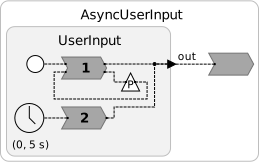
The key line is
int nread = lf_async(awake, getline, &line, &capacity, stdin);
This calls getline(&line, &capacity, stdin) and returns its result, just as a direct call would. But while getline is blocked waiting for the user, the rest of the program keeps running: the timer reaction prints a prompt every five seconds, and any other reactors in the program proceed normally. When getline returns, the physical action awake is scheduled at the current physical time, and the startup reaction continues from the line after lf_async, now at the tag of the physical action. The while loop is an ordinary loop; the local variable line survives the suspension; and no state variables are involved.
A session looks like this:
At logical time 0, Line: 0: Waiting for input...
hello
At logical time 2314876000, Line: hello
At logical time 5000000000, Line: 1: Waiting for input...
world
At logical time 7102351000, Line: world
Each line of input is produced at the logical time equal to the physical time at which the user typed it, which is exactly what you want from a program that reads real-world input.
Two conventions make this work. The action passed to lf_async is listed as a trigger and an effect of the calling reaction.
Strictly speaking, it only needs to be listed as one or the other, but listing it as both makes it clear that the action is both scheduled by the reaction and triggers its resumption.
The Python target
The Python target provides the same operations, exposed as methods of the reactor. The function passed to lf_async is an ordinary Python function, not a coroutine, and the reaction that calls it is an ordinary function too:
reactor UserInput {
  timer t(0, 5 s)
  output out
  state count = 0
  physical action awake

  reaction(startup, awake) -> out, awake {=
    print("Control-D to exit.")
    while True:
      try:
        line = self.lf_async(awake, input)
        # The logical time is now the physical time at which the line was read.
        out.set(line)
      except EOFError:
        request_stop()
        break
  =}

  reaction(t) -> out {=
    out.set(f"{self.count}: Waiting for input...")
    self.count += 1
  =}
}
The key line is:
line = self.lf_async(awake, input)
which calls input() and returns whatever it returns. While input() is blocked, the reaction to the timer t still runs, and the logical time after the call is again the physical time at which the line was typed.
The methods are on self because the runtime needs the reactor that is executing the reaction. The C functions hide that argument inside a macro.
Rather than using a built-in blocking function like input(), you can define the function you wish to call in a file-level preamble. Alternatively, a function defined in a reactor preamble becomes a method of the generated class and would be passed as self.function_name.
This is not Python's async/await. The call does not yield to asyncio, and the reaction does not have to be declared async. It blocks the worker thread, just as the C version does.
Giving a blocking call a logical duration
The action passed to lf_async need not be physical. If it is a logical action with a minimum delay, it is scheduled when lf_async is called, not when the function returns:
logical action done(200 ms)

reaction(startup, done) -> done {=
  int result = lf_async(done, slow_computation, 42);
  // Elapsed logical time is now exactly 200 ms, however long slow_computation(42) took.
=}
In Python, the same program is:
logical action done(200 ms)

reaction(startup, done) -> done {=
  result = self.lf_async(done, slow_computation, 42)
  # Elapsed logical time is now exactly 200 ms, however long slow_computation(42) took.
=}
If slow_computation finishes early, the reaction continues at logical time 200 ms anyway. If slow_computation is still running when logical time reaches 200 ms, the resuming reaction blocks until it returns, holding logical time at 200 ms. Either way, the rest of the program sees the result at exactly 200 ms. This gives the blocking call a deterministic logical duration, independent of how long it actually takes, which is often what a time-sensitive design needs.
lf_await: Suspend Until an Input Arrives
The second function, lf_await, does not call anything. It simply suspends the reaction until an event arrives on the specified input port. The natural use is request-response:
reactor RequestWork {
  input result: int
  output request: int
  timer t(0, 200 ms)
  state count: int = 1

  reaction(t, result) -> request {=
    lf_print("Request work at logical time " PRINTF_TIME, lf_time_logical_elapsed());
    lf_set(request, self->count++);
    lf_await(result);
    lf_print("Result %d received at logical time " PRINTF_TIME, result->value, lf_time_logical_elapsed());
  =}
}

reactor DoWork {
  input request: int
  output result: int

  reaction(request) -> result {=
    lf_set(result, request->value * 2);
  =}
}

main reactor {
  request_work = new RequestWork()
  process_work = new DoWork()
  request_work.request -> process_work.request
  process_work.result -> request_work.result after 100 ms
}
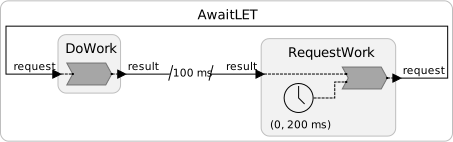
The timer reaction sets the request output, then calls lf_await(result). The output is delivered at the tag of the timer, DoWork responds at that same tag, and the after 100 ms on the feedback connection delivers the result 100 ms later. At that tag, the suspended reaction resumes, yielding the following output:
Request work at logical time 0
Result 2 received at logical time 100000000
Request work at logical time 200000000
Result 4 received at logical time 300000000
...
Notice the port result listed as a trigger of the reaction. It can alternatively be listed as a source, not a trigger, in which case other schedulings of result will not trigger the reaction.
The Python version has the same structure. Ports are read with .value, outputs are written with .set, and the calls are methods:
reactor RequestWork {
  input result
  output request
  timer t(0, 200 ms)
  state count = 1

  reaction(t, result) -> request {=
    print(f"Request work at logical time {lf.time.logical_elapsed()}")
    request.set(self.count)
    self.count += 1
    self.lf_await(result)
    print(f"Result {result.value} received at logical time {lf.time.logical_elapsed()}")
  =}
}

reactor DoWork {
  input request
  output result

  reaction(request) -> result {=
    result.set(request.value * 2)
  =}
}
When self.lf_await(result) returns, result.value is the value that arrived at the new tag.
What this example implements is a logical execution time (LET) pattern. From the perspective of RequestWork, DoWork behaves like a function call that takes exactly 100 ms of logical time, no matter how long the computation in DoWork actually takes. If several reactions of a reactor are waiting on the same port, all of them will be resumed by a single input on the port.
What Happens Under the Hood
In most languages, async/await is implemented by turning the function into a state machine or coroutine. LF's version takes a different route, because reactions in the C target are ordinary C functions, and reactions in the Python target are ordinary Python functions, executed by a pool of worker threads.
When a reaction calls lf_async or lf_await, the runtime first propagates any outputs the reaction has already set, so that downstream reactions see them at the current tag. Then the worker thread executing the reaction leaves the worker pool. If no spare thread is available, a new worker thread is created to take its place. From the scheduler's point of view, the reaction has finished: the remaining workers advance logical time and execute other reactions exactly as they would have. The departed thread sits on the stack of the suspended reaction, either blocked in the user's function or waiting to be resumed. Threads created this way persist for the rest of the run, so the cost is one extra thread per concurrently suspended reaction, not per call. A reaction that loops over lf_async, like UserInput above, reuses a single added thread.
When the reaction resumes, the suspended thread rejoins the worker pool and continues the reaction, at the new current tag.
A consequence of this design is that it works with any C function, unmodified, and with any Python function. There is no need for a special asynchronous API, no coloring of functions into "async" and "sync" variants, and no requirement that the blocking call cooperate.
The Python methods call that same C runtime. Around the parts of the call that can block inside the runtime, the binding releases Python's global interpreter lock (GIL), so the worker that runs the resuming reaction can execute Python code. The function passed to self.lf_async runs with the lock held. Blocking calls in the Python standard library, such as input() and time.sleep, release the GIL themselves. A long stretch of pure Python does not, so other Python reactions will not run simultaneously those stretches but rather will be interleaved with them using the usual Python multithreading mechanisms.
Determinism
What distinguishes this from simply running a thread is that the point at which the reaction continues is a tag, chosen by the program, not by the operating system scheduler. With a logical action, that tag is fully determined by the program. With a physical action, the tag reflects the physical time at which the call returned, which is the right answer when the program is reacting to the outside world. With lf_await, it is the tag at which the awaited input arrives.
Either way, once the reaction continues, the rest of the program sees its outputs at that tag and nowhere else. Other reactions of the same reactor are mutually exclusive with the suspended one, so there are no data races on state variables, although their values may well have changed by the time the reaction resumes. And if the program stops before a resume happens, the suspended call returns at the stop tag, after shutdown reactions have run, so the reaction completes rather than being abandoned.
Trying It Out
lf_async and lf_await are available in the C and Python targets of the current development version of Lingua Franca (or version 0.14 if it has been released when you read this), with the threaded runtime and the default scheduler or the GEDF_NP scheduler. The examples above are in the C and Python collections of the LF playground repo, and the full set of rules and caveats is in the handbook page on Async and Await.