Working with Deadlines


Deadlines in Lingua Franca serve three purposes: they specify real-time requirements, guide scheduling, and provide fault handlers to invoke when real-time requirements are not met. But they can be subtle to use, and, do not guide scheduling as much as we would like. This blog outlines the current state of affairs and lays out ongoing work to improve the situation.
A deadline specifies that the physical time at which a reaction starts minus the logical time of that reaction (a time difference called the lag) should not exceed some threshold. If it does, then the deadline violation handler is invoked rather than the regular reaction.
Deadlines expose a number of scheduling subtleties because unrelated reactions can cause a deadline violation. Moreover, many users wonder why the deadline refers to the physical time at which a reaction starts rather than the time at which it ends. Here, we explain some of the subtleties.
Typical Deadline Pattern
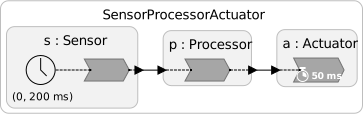
The diagram above depicts a typical pattern, where a periodic reaction polls sensor data, a Processor reactor processes the data, and an Actuator reactor produces some response.
An end-to-end deadline is specified as follows (illustrated in the C target):
reactor Actuator(limit: time = 50 ms) {
  input inp:int
  reaction(inp) {=
    // Regular reaction.
    lf_print("Met deadline. Received %d.",  inp->value);
  =} deadline (limit) {=
    // Deadline violation handler.
    lf_print("******* Missed deadline! Received %d.", inp->value);
  =}
}
The deadline shows up in the diagram with a stopwatch symbol.
In this example, because of the timer in the Sensor reactor, the logical times of the events, relative to the start time, are 0, 200 ms, 400 ms, etc., for all reactions.
If the Actuator reaction is invoked at a relative physical time greater than 50 ms, 250 ms, 450 ms, etc., then the deadline violation handler will be invoked rather than the regular reaction.
It will print "******* Missed deadline!" rather than "Met deadline."
This deadline is an end-to-end deadline because it accounts for any overhead in invoking the sensor, processing its data, communicating between reactors, and scheduling reactions.
It does not account for any processing done in the Actuator reaction; the intent is that this be a quick driver, not doing a significant amount of processing.
Why does a deadline constrain the start time of a reaction rather than the end time?
In a typical usage, it may not make sense to actuate based on late data, so we don't want to execute the regular reaction only to then discover that the deadline was violated.
Hence, in this usage, specifying a deadline on the completion of the Actuator reaction would not make sense.
Specifying a deadline on the completion the Processor reaction would also not make sense.
Usually, nobody cares when processing completes; we only care when the results have an effect in the real world.
If we specified only a completion-time deadline for the Processor reaction, then nothing would constrain when the Actuator reaction is invoked.
Specifying a Deadline on Completion Time
Although the above pattern is typical, it is not uncommon to actually want to specify a deadline on a completion time. Fortunately, this can be easily done with the pattern shown below:
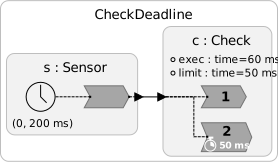
The Check reactor may be specified as follows:
reactor Check(exec = 10 ms, limit: time = 50 ms) {
  input inp:int
  reaction(inp) {=
    lf_sleep(self->exec);
    lf_print("Received %d.", inp->value);
  =}
  reaction(inp) {=
    lf_print("Met deadline.");
  =} deadline (limit) {=
    lf_print("******* Missed deadline!");
  =}
}
This reactor has an exec parameter that specifies an (approximate) execution time, in this test case realized using lf_sleep.
It has a second reaction triggered by the same input that has a deadline given by the limit parameter.
If limit is enough larger than exec, then the deadline will be met.
Otherwise, it will be violated.
This pattern works because reactions belonging to the same reactor are not allowed to execute concurrently (because this would create race conditions accessing state variables). They must execute in sequence, in the order in which they are defined. The numbering in the diagram indicates this ordering.
When an input arrives, both reactions will be triggered. But because the reactions must execute in the sequence that they are defined, a constraint on the start time of the second reaction is effectively a deadline on the completion time of the first reaction.
What keeps other reactions from executing between the invocation of the first reaction and the invocation of the second?
Ideally, the LF scheduler would be using an earliest deadline first (EDF) scheduling policy. Under an EDF scheduling policy, upon completion of the first reaction, the second reaction will have a priority based on the time remaining until its deadline is violated. Under EDF, only another reaction that is also at risk of violating its deadline could execute between these two. However, LF does not (yet) implement EDF.
Scheduling
As of version 0.10.1, the default schedulers in all targets of LF have significant limitations dealing with deadlines and do not implement EDF scheduling. Here, we explain how scheduling works in version 0.10.1 and then outline research efforts towards achieving EDF scheduling.
Level scheduling
The schedulers all use a level scheduling heuristic to ensure that all precedences have been satisfied when a reaction is invoked. At each tag (logical time and microstep), several reactions may be triggered. If there are no dependencies between these reactions, and if there is more than one worker thread, then reactions may be invoked in parallel. But the scheduler has to ensure that precedences are satisfied.
A reaction r1 has precedence over a reaction r2 if there is a path (without after delays) from outputs that r1 writes to to inputs that r2 uses.
In addition, if r1 and r2 belong to the same reactor, and r1 is defined before r2, then r1 has precedence.
If r1 has precedence over r2, then r1 must complete before r2 can start.
For efficiency, the default schedulers use a conservative approach called "level scheduling."
At compile time, the dependencies between reactions are analyzed, and an acyclic precedence graph (APG) is constructed.
The level of a reaction r is defined as the length of the largest upstream chain of reactions that have precedence over r.
If no reaction has precedence over r, its level is zero.
If exactly one reaction has precedence over r, and that reaction does not depend on other reactions, then r has level one. Etc.
The default schedulers all require that all reactions with level n complete before any reaction with level n + 1 can begin. This constraint can cause unexpected deadline violations.
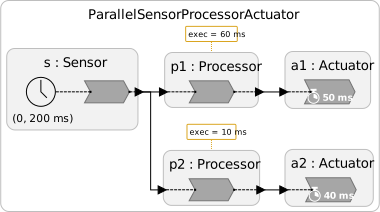
Consider program with the following structure:
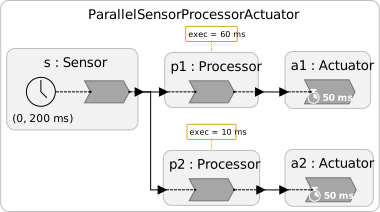
Suppose that p1 has an execution time of 60 ms and p2 has an execution time of 10 ms.
Then we might expect the deadline at a1 to be violated and the deadline at a2 to be met.
But this is not what happens.
The reactions in a1 and a2 both have level 2.
Because of the level scheduling, the reactions in both p1 and p2, which have level 1, must complete before either actuator can be invoked.
Hence, both deadlines are violated.
Federated Execution
One way to get around the level-scheduling limitation is to make the program federated, splitting it into separate processes, each of which will have its own scheduler, as shown here:
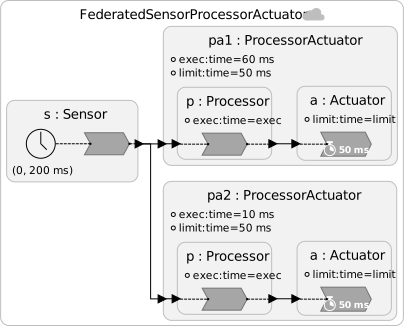
Here, pa1 will consistently miss deadlines (because of the exec parameter value of 60 ms), whereas pa2 will consistently meet the deadline. This structure is defined by the following code:
import Sensor, Processor, Actuator from "SensorProcessorActuator.lf"

reactor ProcessorActuator(exec = 10 ms, limit = 50 ms) {
  input sensor: int
  p = new Processor(exec = exec)
  a = new Actuator(limit = limit)
  sensor -> p.inp
  p.out -> a.inp
}

federated reactor {
  s = new Sensor()
  pa1 = new ProcessorActuator(exec = 60 ms)
  pa2 = new ProcessorActuator()
  s.out -> pa1.sensor
  s.out -> pa2.sensor
}
This can be also be made with two federates rather than three, as shown here:
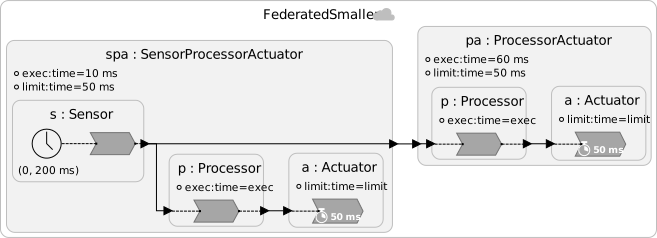
Some care is needed in this case because the code generator inserts a NetworkSender reactor, as shown below:
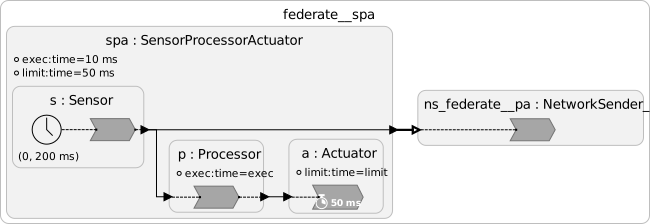
This is a code-generated Lingua Franca file for the spa federate alone.
In this case, the reaction in the NetworkSender will have the same level as the reaction in the Processor and hence may get delayed, causing the deadline to be missed at the pa federate.
Early Deadline Violation Detection
A deadline violation handler is invoked when a reaction is to be started late. Above, we explained how to react to a late completion time of a reaction, but the handler is not invoked until the reaction actually completes. What if you need to react as soon as you know that the completion time will be late? Here we describe three complementary mechanisms that can react sooner.
Reactions that Monitor Their Execution Time
The lf_check_deadline function in the reactor API can be used to write a reaction that monitors its own execution time against a deadline and invokes its deadline violation handler as soon as it detects that the execution time has exceeded the deadline.
This mechanism works when the reaction is started on time, but when we want it to terminate its execution when it cannot complete on time.
A nice example of this is given in the AnytimePrime.lf example in the deadline collection of the LF playground repo.
It computes as many prime numbers as it can before exceeding a time budget and then aborts.
Federates as Watchdog-Like Monitors
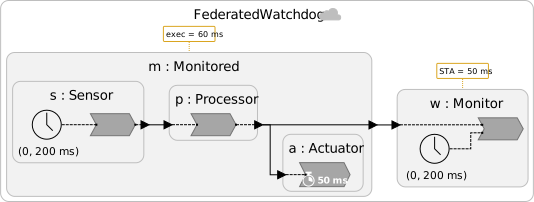
The decentralized coordinator for federated execution gives a convenient mechanism for creating a form of watchdog-like monitor that runs in a separate process or even on a separate machine. This can give a robust detection of a failure because the monitor can be put on a separate machine from the process being monitored.
Consider the following example:
target C {
  coordination: decentralized
}
import Sensor, Processor, Actuator from "SensorProcessorActuator.lf"

reactor Monitored(exec = 10 ms) {
  output complete:int
  s = new Sensor()
  p = new Processor(exec = exec)
  a = new Actuator()
  s.out -> p.inp
  p.out -> a.inp
  p.out -> complete
}

reactor Monitor(STA: time = 50 ms) {
  input inp:int
  timer t(0, 200 ms)

  reaction(t, inp) {=
    if (!inp->is_present) {
      lf_print("%s: ******* Failed to receive input on time at logical time " PRINTF_TIME,
          lf_reactor_name(self), lf_time_logical_elapsed());
    } else {
      lf_print("%s: Monitor OK at logical time " PRINTF_TIME,
          lf_reactor_name(self), lf_time_logical_elapsed());
    }
  =} STAA(0) {=
    lf_print("%s: ******* Monitor received late input.", lf_reactor_name(self));
  =}
}

federated reactor {
  @label("exec = 60 ms")
  m = new Monitored(exec = 60 ms)
  @label("STA = 50 ms")
  w = new Monitor()
  m.complete -> w.inp
}
The Monitored reactor is simply a federate containing the sensor-processor-actuator chain.
It is just like above except that it also copies the output of the processor to its own complete output.
The Monitor federate has a timer that exactly matches the Sensor timer in offset and period.
The Monitor expects an input from Monitored at each tick of this timer.
The STA parameter (safe to advance) specifies that it is safe to advance the federate's logical time to the logical time of the timer tick when physical time exceeds that logical time plus the STA even if input status is unknown.
The STA is set to 50 ms, so, at physical times 50 ms, 250 ms, 450 ms, etc. after the start time, if an input has not arrived, then the input will be assumed to be absent and the Monitor's reaction will be invoked.
The reaction, therefore, just has to check whether the input is present.
If it is, then the Monitored federate is alive and well and its processor output was received by the Monitor within 50 ms.
Otherwise, something has gone wrong that has led to a delay greater than 50 ms.
Watchdogs
An experimental watchdog mechanism is available in LF and is described by
Asch, et al., Software-Defined Watchdog Timers for Cyber-Physical Systems.
A watchdog specifies a handler that is invoked if, after the watchdog is started using the lf_watchdog_start function in the reactor API, the watchdog is not stopped or restarted within the specified amount of physical time.
A typical usage is to start a watchdog before a potentially problematic reaction is invoked and then stop the watchdog upon completion of the reaction. As soon as the reaction takes too long to complete, the watchdog handler will be invoked.
Using watchdogs is tricky because the watchdog handler requires a mutual exclusion lock in order to safely access state variables (see Asch, et al.. For this reason, federates (or, in the future, enclaves) are preferred.
Ongoing Research
Several significant efforts are under way to improve the real-time behavior of LF and to guide scheduling using deadlines. Some early work is reported in Paladino, et al., Layered Scheduling: Toward Better Real-Time Lingua Franca. That work makes use of an early version of the enclaves mechanism, described below. It leverages priority-based thread scheduling in the standard Linux kernel. Here, we focus on what is currently available (as of version 0.10.1 and 0.10.2-SNAPSHOT) in LF.
The overarching goal is that reactions with deadlines that are closest to expiring should be given priority and executed as soon as all their precedences have been satisfied. I.e., ideally, LF would implement EDF. But it does not. Yet. Here, we describe some steps towards achieving such a scheduling policy with LF.
GEDF_NP Scheduler
An early experiment is a scheduler called GEDF_NP, which has some initial efforts towards achieving EDF scheduling, although it has many limitations.
This scheduler is specified using a target property as follows:
target C {
  timeout: 1 s,
  scheduler: GEDF_NP
}
Unlike the default scheduler, this one takes deadlines into account when sorting events on the event queue. Consider the following example:
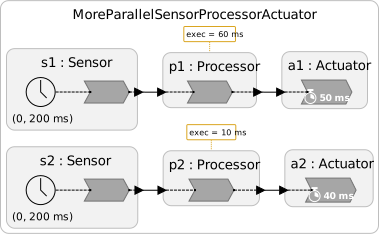
For the purposes of sorting events on the event queue, the GEDF_NP scheduler propagates deadlines upstream from reactions where they are declared.
In this example, the processors and sensors inherit the deadlines of the actuators that they drive.
Hence, sensor s2 will be treated as if it has a deadline of 40 ms, while s1 will be treated as if it has a deadline of 50 ms.
The timers in each of these sensors have identical periods and offsets, so their events would normally not have any particular ordering.
The GEDF_NP scheduler, however, for events with identical tags, gives priority to those with earlier deadlines.
In the above example, it will pull the timer event for s2 from the event queue and process all reactions that this triggers before pulling the timer event for s1.
As a consequence, it overcomes the level-scheduling limitation, and a2 will meet its deadline.
There are several downsides to this approach, however.
First, it sacrifices parallelism.
In the above example, suppose that both Processor reactors have an execution time of 30 ms.
In a dual-core (or more) processor, it should be possible to meet both deadlines.
However, the GEDF_NP scheduler processes all the reactions triggered by the timer in s2 before even fetching the timer event for s1.
As a consequence, it will miss the deadline in a1.
If the deadlines are made identical, however, both 50 ms, then both deadlines will be met if there are two cores.
Second, the GEDF_NP scheduler only considers (inherited) deadlines when sorting the event queue.
Events that do not pass through the event queue are unaffected.
As a consequence, in the following example, both deadlines are missed, even if the deadlines are identical:
At each tag, there is only one event, the one for the timer in the s sensor.
The reaction in s will have an inherited deadline of 40 ms (the smaller of the two downstream deadlines), but there is no other competing event with the same tag, so the GEDF_NP scheduler will have no effect.
Third, the GEDF_NP scheduler underperforms the default scheduler by a considerable margin.
It is slower.
As a consequence of these limitations, the GEDF_NP scheduler is likely to be retired.
Enclaves
As of version 0.10.2-SNAPSHOT, the development version after the 0.10.1 release, there is some support for scheduling enclaves.
These are similar to federates, in that they create separated scheduling domains, but they execute within the same process as their container.
Such an enclave can be created using an @enclave annotation, as shown here:
main reactor {
  ...
  @enclave
  pa = new ProcessorActuator(exec = 60 ms)
  ...
}
The resulting diagram shows a red outline for the enclave:
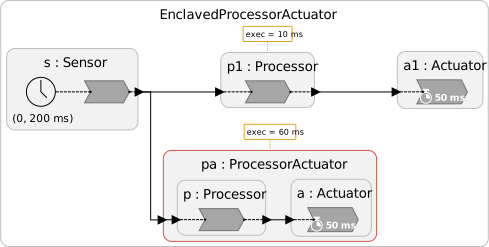
In this case, as with the federate execution, the deadline will be systematically met at actuator a1 but missed at actuator pa.a.
As with federated execution, there is a subtlety because an EnclaveCommunication reactor is inserted on the communication path to the enclave.
It has two reactions separated by a logical action, so, for this particular structure, the reaction that sends data to pa will have the same level as the reaction in p1.
Enclaves realize the equivalent of centralized coordination, which makes sense because they all run in the same process.
However, this means that the FederatedWatchdog example cannot be converted as-is to use enclaves.
A similar monitor, however, can be created using a physical connection.
The goal of enclaves is to achieve the same decoupling as with federates, but with all enclaves executing in the same process and communicating via shared memory.
Conclusions
Today, the deadline mechanism in LF provides a useful mechanism for detecting and reacting to timing anomalies. But LF does not yet have an effective scheduler that prioritizes reactions with earlier deadlines.